Physical AI
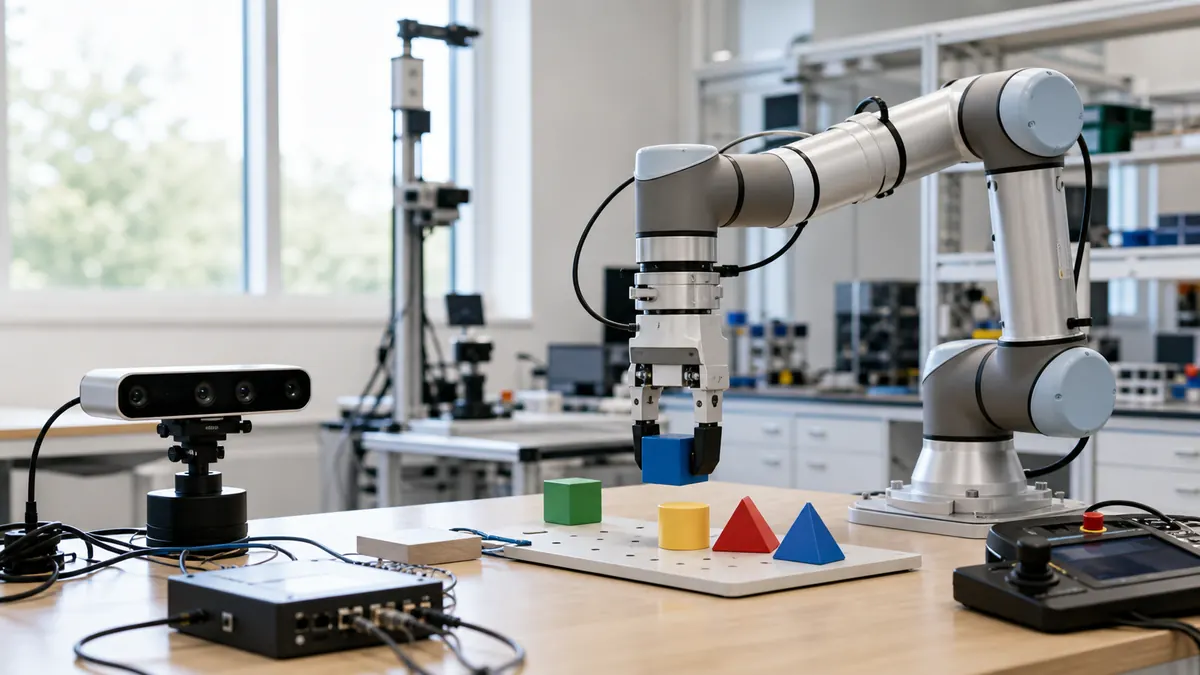
AI systems that perceive, reason, and act through physical machines in the real world.
Open topicCommunity research index
A structured roadmap through robotics, world models, embodied intelligence, and vision-language-action systems, built for students, builders, and researchers.
Interactive roadmap
Select a stage to see its role and open the full lesson.
Direct answer
Start with linear algebra, probability, Python, machine learning, computer vision, robotics, and control. Then study robot learning, world models, and vision-language-action systems in that order.
Core curriculum
AI systems that perceive, reason, and act through physical machines in the real world.
Open topicThe mathematics, programming, machine learning, vision, and robotics concepts needed to study Physical AI.
Open topicIntelligence that emerges through an agent's body, sensors, actions, and interaction with an environment.
Open topicLearned models that predict environment dynamics and possible future outcomes.
Open topicModels that map visual observations and language instructions to robot actions.
Open topicMethods that allow robots to acquire behavior from demonstrations, rewards, interaction, or generated experience.
Open topicResearch archive
A compact latent model can let an agent learn behavior inside its own predicted environment.
Dreamer learns long-horizon behavior by propagating value gradients through imagined latent trajectories.
DreamerV2 extends latent imagination with discrete representations and reaches human-level Atari performance.
DreamerV3 uses robust normalization and objectives to learn across more than 150 tasks with one configuration.
RT-1 trains one transformer policy on a large multi-task dataset of real robot demonstrations.
RT-2 co-trains vision-language models on web and robot data so semantic knowledge can influence actions.
Common questions
Physical AI is artificial intelligence that perceives, reasons, and acts through robots or other physical systems under real-world constraints.
Start with programming, linear algebra, machine learning, computer vision, robotics, and the perception-action loop before reading advanced VLA or world-model papers.
A vision-language-action model connects images and natural-language instructions to actions that a robot can execute.